[Important Notice for US Customers]
Due to current US import regulations, please contact us before placing your order. We will confirm the shipping cost, import duties and taxes applicable to your order and provide you with the final amount before payment. ▶Contact usYAMANI SHODOSHIMA
Sakai Takayuki 210mm & 240mm Gyuto - VG10 33-Layer Hammered Damascus
Sakai Takayuki 210mm & 240mm Gyuto - VG10 33-Layer Hammered Damascus
Couldn't load pickup availability
Japanese Cutting Performance, Made for Everyday Use
Experience a refined balance of traditional Sakai craftsmanship and modern Japanese high-performance steel with the Sakai Takayuki VG10 33-Layer Hammered Damascus Gyuto.
You want the sharp, precise cutting performance that makes Japanese knives so highly regarded.
But you may not want a knife that demands constant attention to rust, discoloration, and maintenance.
And if you are investing in a quality Japanese knife, it should offer more than sharpness alone. It should be versatile enough to handle everyday work, comfortable enough to use regularly, and beautiful enough to make reaching for it a pleasure.
This Sakai Takayuki Gyuto brings those qualities together.
Built around a VG10 stainless cutlery steel core, surrounded by a distinctive 33-layer Damascus construction and finished with a traditional Tsuchime hammered texture, it combines Japanese cutting performance, corrosion resistance, edge retention, everyday practicality, and visual craftsmanship in one highly versatile knife.
Designed for both professional chefs and serious home cooks, the Gyuto can comfortably handle meat, fish, vegetables, herbs, and a wide range of everyday preparation.
Available in 210mm and 240mm.
Why VG10? — A Japanese Steel Created for Cutlery
VG10, also known in Japan as V-Gold No.10 (V金10号), is not simply a general-purpose stainless steel adapted for kitchen knives.
It is a Japanese cutlery steel produced by TAKEFU SPECIAL STEEL CO., LTD. in Echizen, Fukui Prefecture — an area with a long history of Japanese blade-making.
TAKEFU SPECIAL STEEL was founded in 1954 in the former city of Takefu, originally supplying steel materials to the traditional Echizen cutlery industry.
From this background, the company developed and produced specialist steels specifically for knives and other cutting tools, including its original V-series steels.
VG10 became one of the most recognized steels within that family.
Containing chromium, molybdenum, vanadium, and cobalt, VG10 was engineered to provide a carefully balanced combination of hardness, edge retention, wear resistance, corrosion resistance, and sharpenability.
In this Sakai Takayuki knife, the VG10 core is hardened to approximately 60–61 HRC, providing excellent edge retention while remaining practical for a working kitchen knife.
But for the person actually using the knife, the chemistry and hardness numbers are not the most important part.
What matters is what those properties do for you:
A sharp, precise cutting edge.
An edge that stays sharp through regular use.
Less concern about rust in everyday cooking.
And a knife that can be sharpened again and again rather than simply replaced.
Traditional Japanese carbon steels have their own exceptional qualities, but they also require greater attention to moisture, rust, and discoloration.
VG10 offers another solution.
It brings serious Japanese cutting performance into a stainless steel that is considerably easier to live with in a modern professional or home kitchen.
A Japanese steel developed for cutting tools, born from one of Japan’s historic blade-making regions.
That is the steel at the heart of this Sakai Takayuki Gyuto.
33-Layer Damascus — Beauty Built Around the Cutting Core
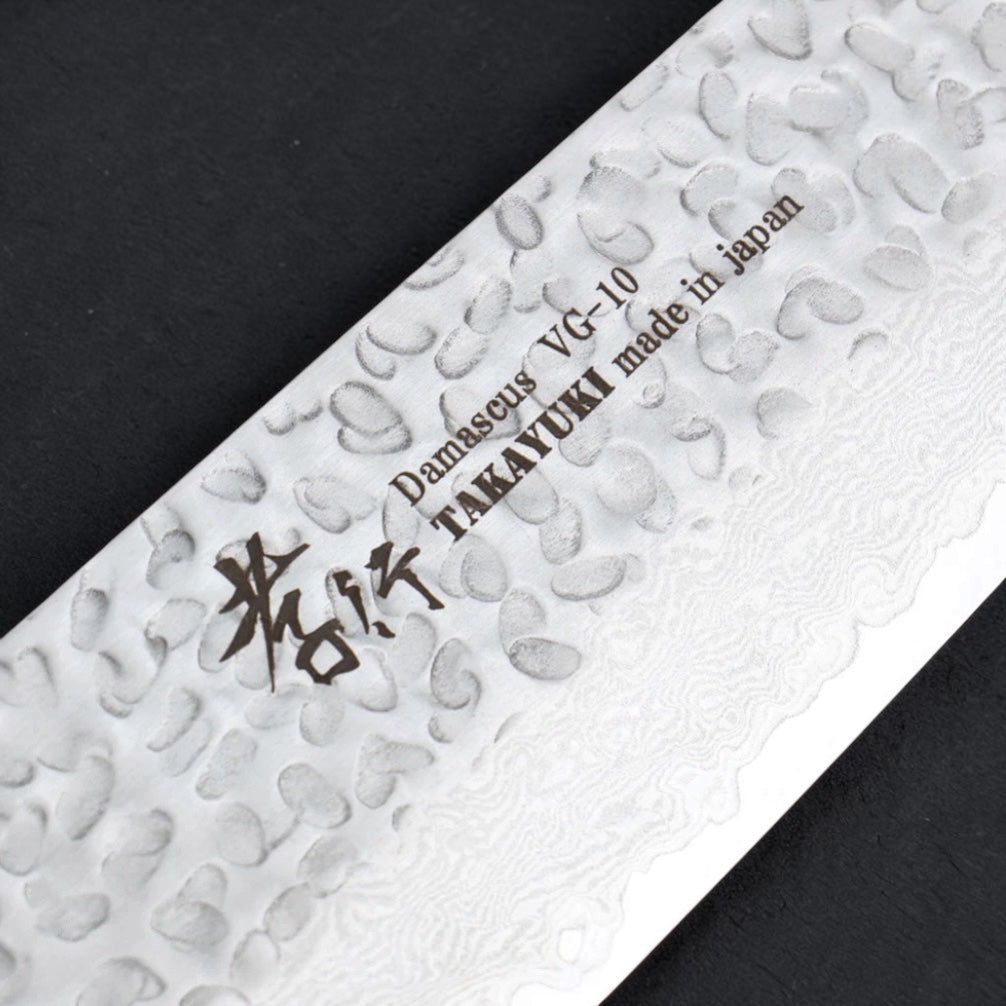
The VG10 cutting core is combined with multiple layers of stainless steel to create the distinctive 33-layer Damascus construction.
Across the surface of the blade, these layers form flowing, wave-like patterns that give the knife its unmistakable visual character.
The result is more than a plain stainless-steel working knife.
Every time the blade catches the light, the layered pattern reveals another aspect of its construction, giving the knife a distinctive presence without compromising its everyday practicality.
It brings together two qualities that do not always coexist:
A knife designed to work — and a knife you can take pleasure in owning.
Tsuchime Hammered Finish — More Than Decoration
The blade is further finished with a distinctive Tsuchime, or hammered texture.
The hammered surface gives the knife its characteristic Japanese appearance while creating small variations across the surface of the blade.
These shallow depressions reduce the amount of completely flat blade surface contacting food and can help with food release during cutting.
Rather than treating appearance and function as separate ideas, the Tsuchime finish brings them together.
The combination of the flowing Damascus pattern and hammered surface creates a knife that looks unmistakably Japanese while remaining first and foremost a practical cutting tool.
One Gyuto for Most Everyday Kitchen Tasks
Although Gyuto literally translates as “beef sword,” the modern Japanese Gyuto is one of the most versatile knife shapes in the kitchen.
It is the Japanese interpretation of the all-purpose chef’s knife and is suitable for far more than meat alone.
Meat, fish, vegetables, herbs, and general preparation can all be handled with one well-chosen Gyuto.
For someone who would rather own one dependable, high-quality knife than several specialized knives that are rarely used, a Gyuto is an exceptionally practical choice.
210mm
The 210mm version offers an excellent balance between cutting length and maneuverability.
It works comfortably in most home kitchens while remaining fully capable in a professional environment.
For someone purchasing a serious Japanese Gyuto for the first time, 210mm is also an exceptionally versatile starting point.
240mm
The 240mm version provides additional cutting length and efficiency.
It is particularly well suited to professional chefs, larger ingredients, higher-volume preparation, and experienced users who prefer the reach and cutting rhythm of a longer chef’s knife.
Mahogany Pakkawood Handle — Made for Everyday Work
The knife is fitted with a Western-style mahogany Pakkawood handle, offering durability and water resistance while retaining the warm appearance of wood.
Pakkawood is particularly well suited to a knife intended for regular kitchen use because it provides greater stability against moisture than untreated natural wood.
The handle is paired with a stainless-steel bolster, creating a smooth transition between blade and handle while contributing to a secure, comfortable grip.
For a knife designed to be used rather than merely admired, these details matter.
Not “Too Special to Use” — Special Enough to Use Every Day
Some high-end Japanese knives deliver extraordinary performance but also demand considerable knowledge and maintenance from their owners.
That is not where the strength of this Sakai Takayuki VG10 Gyuto lies.
Its appeal comes from the balance it achieves:
Sharp Japanese cutting performance.
Excellent edge retention.
The practicality and corrosion resistance of stainless steel.
The versatility of Gyuto geometry.
The durability of a Pakkawood handle.
And the distinctive beauty of 33-layer Damascus and Tsuchime finishing.
This makes it an excellent choice for someone purchasing a serious Japanese knife for the first time.
It is equally suitable for someone who appreciates traditional carbon-steel knives but wants a stainless knife that requires less attention during everyday use.
And for professional chefs, it offers a practical Japanese Gyuto that can comfortably become part of the daily working rotation.
It is a knife that does not force you to choose between “easy to use” and “worth owning.”
Optional Wooden Saya
A wooden saya (knife sheath) is available as an option.
For professional chefs carrying their knives in a knife bag or roll, a saya is more than a traditional accessory.
It helps protect the cutting edge during transportation and storage while also helping prevent the blade from damaging the inside of a knife bag or other equipment stored alongside it.
It is equally useful for safe storage at home and gives the knife a more complete Japanese presentation.
Why YAMANI Selects This Knife
At YAMANI SHODOSHIMA, we do not judge a knife only by how impressive it looks when it is new.
We consider what happens afterwards.
Use it. Sharpen it. Use it again.
A good knife should continue to serve its owner through that cycle for years.
From our perspective as specialists involved in knife sharpening and restoration, the Sakai Takayuki VG10 Gyuto offers an especially convincing balance for everyday use.
It delivers the cutting performance expected from a Japanese knife without making maintenance unnecessarily demanding.
Its Gyuto profile is versatile rather than overly specialized.
Its VG10 core provides a practical combination of sharpness, edge retention, corrosion resistance, and resharpenability.
And although it is fundamentally a working tool, the 33-layer Damascus construction and hammered finish provide the craftsmanship and visual character that make owning a Japanese knife something special.
For someone asking:
“I want to buy my first serious Japanese knife, but I’m not sure where to begin.”
this is exactly the kind of knife YAMANI can recommend with confidence.
An exceptional knife does not have to be difficult to own.
Sometimes, one of the best signs of a good knife is simply that you find yourself reaching for it every day.
Specifications
Brand: Sakai Takayuki
Knife Type: Gyuto / Japanese Chef’s Knife
Available Blade Lengths: 210mm / 240mm
Core Steel: VG10 Stainless Cutlery Steel
Blade Construction: 33-Layer Damascus with Tsuchime (Hammered) Finish
Hardness: Approx. 60–61 HRC
Handle Material: Mahogany Pakkawood
Handle Style: Western-Style Handle with Stainless-Steel Bolster
Edge: Double-Bevel
Optional Accessory: Wooden Saya (Knife Sheath)
Country of Origin: Japan
Production Region: Sakai, Osaka
Share