YAMANI SHODOSHIMA
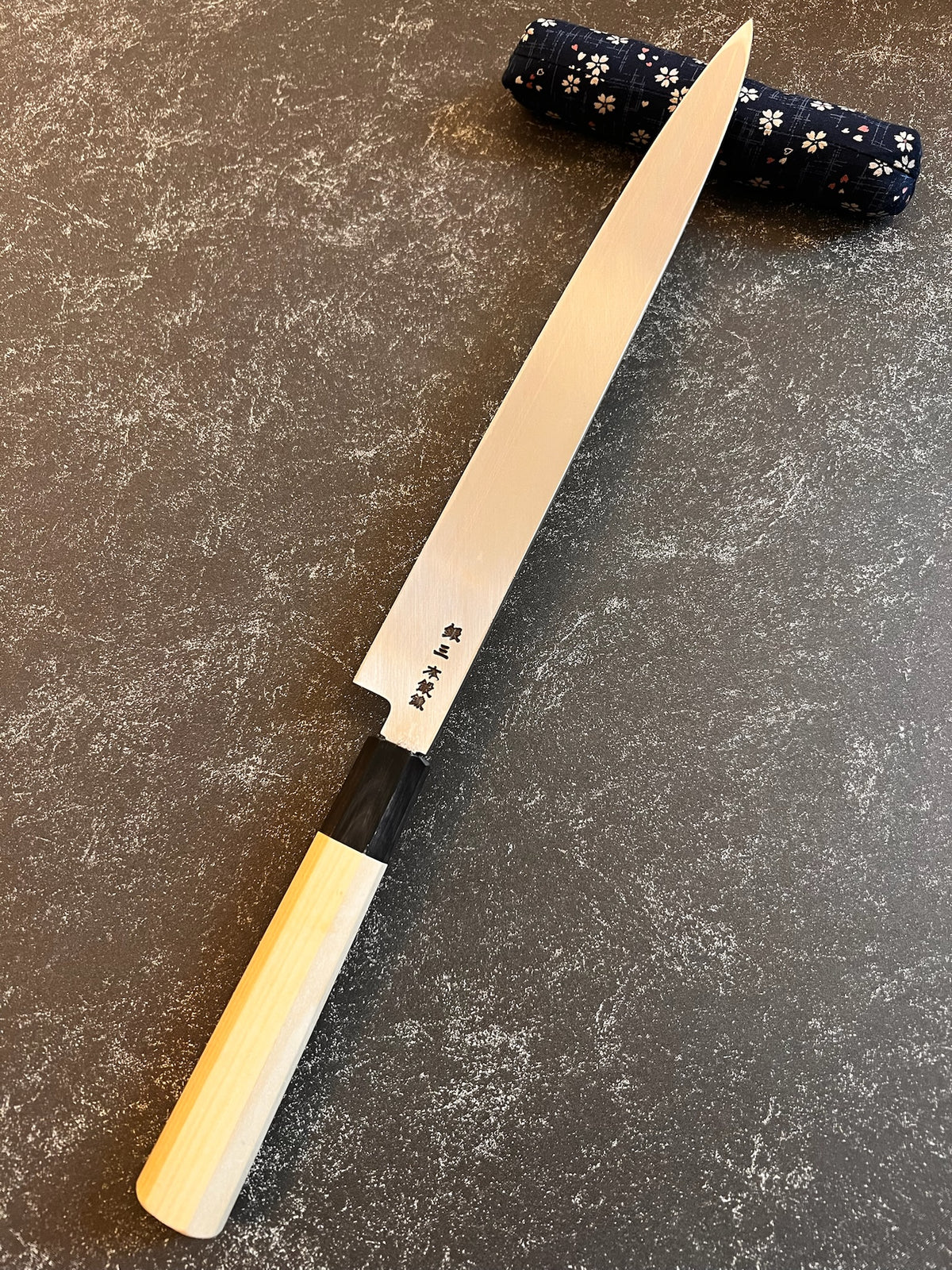
Shotaro Nomura Yanagiba - Silver #3 (Gingami #3 / Ginsan) Kasumi Finish with Signed Saya
Shotaro Nomura Yanagiba - Silver #3 (Gingami #3 / Ginsan) Kasumi Finish with Signed Saya
【Made to Order / Request Order】
This knife is made to order after your request is confirmed. It is not a regular ready-stock item. Each piece is prepared individually upon order.
240mm / 270mm / 300mm / 330mm — Request Order
For Chefs Who Want the Performance of a Traditional Yanagiba — Without the Constant Concern of Carbon Steel
A serious Yanagiba is not simply about being sharp.
When preparing sashimi or sushi, the objective is to make a long, clean slice through the ingredient with minimal unnecessary movement — preserving the surface, texture, and presentation of the fish.
The cut itself becomes part of the finished dish.
Traditional Japanese carbon steels such as Shirogami and Aogami can produce exceptional cutting edges. But in a demanding professional kitchen, they also require careful attention to moisture, salt, acidity, rust, and discoloration.
For some chefs, that creates a difficult choice:
You do not want to compromise on cutting performance.
But you also do not want knife maintenance to interrupt your work.
Ginsan offers another answer.
And when that steel is shaped into a traditional single-bevel Yanagiba by Sakai Traditional Craftsman Shotaro Nomura, it becomes far more than simply a “stainless Japanese knife.”
Ginsan — A Japanese Cutlery Steel Created to Bridge Two Worlds
Ginsan, also known as Silver #3 or GIN®3, is a Japanese stainless cutlery steel produced by Proterial, Ltd., formerly Hitachi Metals.
Hitachi Metals changed its corporate name to Proterial in January 2023, but its long history in Japanese specialty steels continues under the Proterial name.
GIN®3 occupies a particularly interesting position among Japanese blade steels.
Proterial describes GIN®3 as a stainless steel offering hardness and sharpness comparable to carbon steel, and specifically lists kitchen knives and scissors among its applications.
That distinction matters.
Traditional carbon steels are highly valued by Japanese knife users because they can take extremely fine, sharp edges and respond beautifully to sharpening.
Stainless steel, on the other hand, offers the practical advantage of greater corrosion resistance.
Ginsan brings these two worlds remarkably close together.
For the chef, the benefit is not simply a technical specification.
It means:
The fine cutting performance expected from a serious Japanese knife.
A precise edge that responds well to sharpening.
The ability to maintain and resharpen the knife over years of use.
And significantly less concern about rust than with traditional carbon steel.
In other words, Ginsan is not a steel to choose simply because it is easier to maintain.
It is stainless steel capable of becoming a serious traditional Japanese knife.
And for a Yanagiba — a knife where precision of the edge and quality of the cut matter enormously — that combination makes particular sense.
Why a Yanagiba Changes the Cut
A Yanagiba is fundamentally different from an ordinary chef’s knife.
Its long, narrow blade and traditional single-bevel geometry are designed to allow the chef to draw the blade through fish in a long, controlled slicing motion.
Instead of repeatedly sawing through an ingredient, the length of the blade allows a clean slice to be completed with fewer movements.
The benefit is not merely “sharpness.”
It can influence:
The cleanliness of the cut.
The appearance of the cut surface.
The texture experienced in the mouth.
And ultimately, the presentation of the finished dish.
For a sushi or sashimi chef, the knife is not simply a tool for making ingredients smaller.
It is one of the final tools that determines how the ingredient reaches the guest.
Crafted by Sakai Traditional Craftsman Shotaro Nomura
This Yanagiba is crafted by Shotaro Nomura, a certified Sakai Traditional Craftsman.
With a traditional single-bevel Japanese knife, the name of the steel alone does not determine the quality of the finished knife.
Steel matters.
But so do the blade geometry, thickness, Shinogi line, bevel, Ura, edge formation, and the relationship between all of these elements.
Two knives can carry the same steel designation and still behave very differently in cutting, sharpening, and long-term use.
This is why YAMANI looks beyond the question:
“What steel is it?”
We also ask:
“Who made the knife from that steel?”
The value of Ginsan is ultimately realized through the skill of the craftsman who turns that steel into a functioning Yanagiba.
Four Lengths — Choose the Knife for Your Work
There is no single “best” Yanagiba length for every chef.
The right choice depends on your working environment, the size of fish you regularly prepare, available cutting-board space, volume of work, and your own cutting technique.
This Yanagiba is available by Request Order in four sizes:
240mm
Compact and maneuverable.
A practical choice for smaller workspaces, lighter preparation, or users who prioritize control and ease of handling.
270mm
An excellent balance between maneuverability and the longer drawing stroke that defines a Yanagiba.
A versatile choice for chefs who want traditional Yanagiba performance without moving immediately to a 300mm blade.
300mm
One of the classic professional lengths for serious sushi and sashimi preparation.
The additional length allows the chef to take advantage of a longer, smoother drawing motion through the ingredient.
330mm
For chefs who work with larger ingredients, prefer a longer slicing stroke, and are comfortable handling a substantial traditional Yanagiba.
The longest knife is not automatically the best knife.
The best Yanagiba is the length that works naturally with your technique and your kitchen.
Kasumi Finish — Quiet Beauty with the Character of a Traditional Japanese Knife
This Yanagiba features a traditional Kasumi finish.
It is not designed to attract attention through excessive decoration.
Instead, its character comes from the functional geometry of the traditional Japanese blade and the subtle contrast created across its finished surfaces.
The result is restrained and unmistakably Japanese.
It is a knife intended to develop character through use, sharpening, and years of professional work — rather than simply remain untouched as an object of display.
Signed Wooden Saya
A wooden Saya (knife sheath) is included with this Yanagiba.
The Saya protects the blade during storage and transportation and is particularly useful for professional chefs carrying knives in a knife bag or case.
But there is another detail that makes this Saya special.
The Saya carries Shotaro Nomura’s signature.
It is a subtle reminder that this is not simply an anonymous, mass-produced kitchen knife.
It identifies the craftsman behind the work and becomes part of the character of the knife itself.
Request Order
Rather Than Choosing What Happens to Be in Stock, Request the Knife That Fits Your Work
This knife is generally offered as a Request Order rather than maintained as regular inventory.
We do not see that as a disadvantage.
It is part of how this knife should be selected.
Choose the length that suits your work:
240mm / 270mm / 300mm / 330mm
After receiving your request, YAMANI will confirm the current specifications, production availability, and estimated lead time with the craftsman.
We will then provide you with the details before payment.
Once the specifications and estimated lead time have been agreed upon, the order and payment will be confirmed and production can proceed.
Order Process
Request Order → Specifications & Lead Time Confirmation → Order Confirmation → Payment → Production
This means you are not simply choosing whichever knife happens to be sitting on a shelf.
You decide what your work requires, and request that knife from the craftsman.
For a professional tool intended to be sharpened, maintained, and used for years, we believe that is a meaningful difference.
Why YAMANI Selects This Knife
At YAMANI SHODOSHIMA, we do not judge a Yanagiba only by how sharp or beautiful it is when new.
Our perspective comes from sharpening and restoration.
We consider what happens after the knife begins its working life.
How will it sharpen?
How will its geometry respond to repeated sharpening?
Can its shape and function be maintained over years of use?
And can it remain a trusted working tool rather than simply an impressive knife on the day it is purchased?
That perspective is particularly important with traditional single-bevel knives.
Shotaro Nomura’s Ginsan Yanagiba offers a compelling solution for chefs who want the structure, precision, and cutting character of a traditional Japanese Yanagiba while reducing the maintenance burden associated with carbon steel.
But the reason to choose this knife is not simply that it is made from Ginsan.
The steel is only the beginning.
What matters is what a skilled craftsman makes from it.
Ginsan provides an exceptional foundation: stainless practicality combined with cutting characteristics that Proterial itself describes as comparable in hardness and sharpness to carbon steel.
Shotaro Nomura turns that material into a traditional Sakai Yanagiba.
And the Request Order system allows the chef to select the length appropriate for his or her own work rather than simply accepting whatever happens to be available.
This is not about buying another knife.
It is about choosing a professional tool that you can use, sharpen, maintain, and continue working with for years to come.
Specifications
Craftsman: Shotaro Nomura — Sakai Traditional Craftsman
Knife Type: Yanagiba
Available Sizes: 240mm / 270mm / 300mm / 330mm
Steel: Ginsan / Silver #3 / GIN®3 Stainless Steel
Finish: Kasumi Finish
Edge: Single-Bevel / Right-Handed
Saya: Wooden Saya with Craftsman’s Signature
Order Type: Request Order
Production Region: Sakai, Osaka, Japan
Share