[Important Notice for US Customers]
Due to current US import regulations, please contact us before placing your order. We will confirm the shipping cost, import duties and taxes applicable to your order and provide you with the final amount before payment. ▶Contact usYAMANI SHODOSHIMA
Double-Sided Diamond Whetstone Flattening Plate #120 / #180
Double-Sided Diamond Whetstone Flattening Plate #120 / #180
Couldn't load pickup availability
When a Whetstone Needs More Than Routine Maintenance
A whetstone does not always wear evenly.
With repeated sharpening, the center may become hollow, certain areas may wear faster than others, and eventually the surface can become too uneven for accurate sharpening.
At that point, the stone needs more than light surface maintenance.
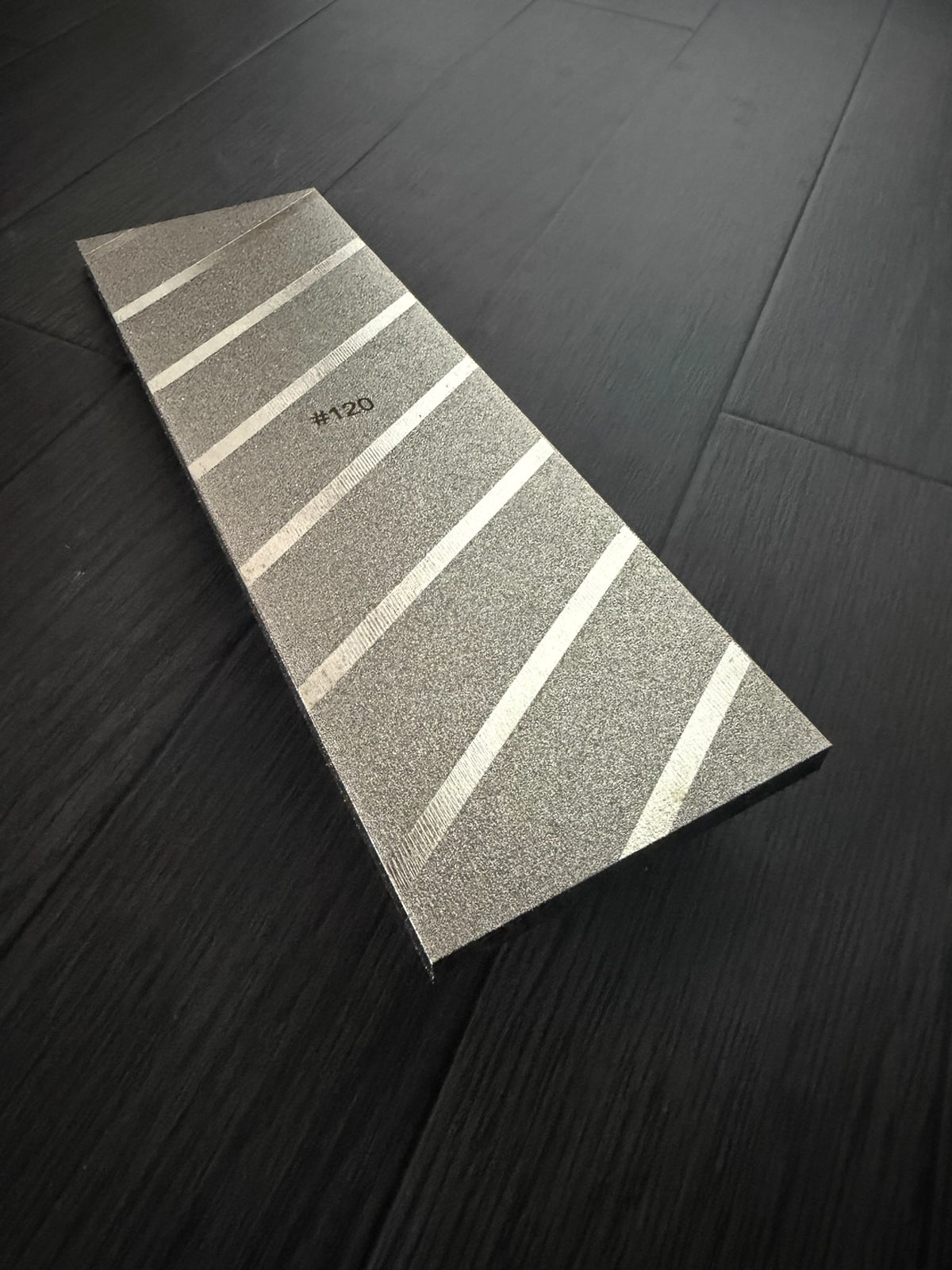
The Double-Sided Diamond Whetstone Flattening Plate #120 / #180 is designed for efficient flattening, substantial surface correction, and restoring noticeably dished or uneven whetstones.
Its coarse electroplated diamond surfaces remove stone material efficiently, helping bring a worn sharpening stone back to a flat and reliable working surface.
Correct the surface. Restore the foundation. Then sharpen accurately again.
Two Coarse Surfaces. Two Levels of Correction.
The double-sided electroplated diamond construction provides two levels of coarse surface correction in a single substantial plate.
#120 — Fast Correction
The #120 diamond surface provides strong cutting action when significant material needs to be removed.
It is particularly useful for restoring whetstones that have developed noticeable dishing, uneven wear, or surface irregularities that require efficient correction.
Rather than spending unnecessary time slowly working down the high areas of a badly worn stone, #120 allows you to establish flatness more efficiently.
#180 — Controlled Correction
The #180 side provides a slightly more controlled abrasive action while retaining the cutting ability required for effective flattening.
It can be used for less severe correction or as the next stage after #120 when greater control over the resulting stone surface is desired.
Together, the two surfaces allow you to move from strong initial correction to more controlled flattening using a single tool.
A Dished Stone Changes More Than the Stone
An uneven whetstone does not simply look worn.
It changes the surface against which your knife is being sharpened.
As dishing becomes more pronounced, maintaining consistent blade-to-stone contact becomes increasingly difficult. This can influence bevel geometry, pressure distribution, and the consistency of your sharpening.
The problem becomes particularly noticeable when working with larger contact areas.
Japanese single-bevel knives, wide bevels, thinning work, and geometry correction all depend heavily on having a reliable reference surface beneath the blade.
If the reference surface is wrong, the work performed on it can gradually become wrong as well.
Before correcting the blade, make sure the surface beneath it is correct.
Designed Specifically for Whetstone Flattening
This is not simply a general-purpose diamond abrasive plate.
These diamond flattening tools are developed specifically for maintaining whetstones used in knife sharpening, with the working surface designed to provide the flatness required for this purpose.
That distinction matters.
When a flattening tool is used to establish the reference surface of a sharpening stone, the accuracy of the tool itself directly influences the surface you create.
A plate intended for general grinding or material removal may contain diamond abrasive, but that alone does not necessarily make it suitable as a reference for precision whetstone maintenance.
Here, the diamond surface is designed with knife-sharpening whetstone flattening in mind, helping restore a consistent working plane from which accurate sharpening can begin.
The tool used to create a flat stone must itself be designed for the job.
Restore a Worn Stone Efficiently
When a whetstone has become substantially uneven, restoring flatness requires removing the high areas until the entire working surface reaches the same plane.
That means material must be removed.
Trying to perform substantial correction with an abrasive that cuts too slowly can turn a straightforward maintenance job into a lengthy process.
The coarse #120 / #180 electroplated diamond surfaces are designed to make that correction more efficient.
The objective is not aggressive material removal for its own sake.
It is to remove the material necessary to restore an accurate working surface efficiently and with control.
Give Valuable Whetstones a Second Working Life
A dished whetstone is not necessarily a finished whetstone.
Even stones with considerable usable thickness remaining can become frustrating to sharpen on simply because their surfaces have been allowed to wear unevenly.
Proper flattening can restore that working surface and allow the remaining stone to continue doing the job it was designed to do.
This is especially important with frequently used professional stones and valuable sharpening stones, where replacing a stone simply because it has become uneven would be unnecessary.
A worn surface can be corrected. A good stone may still have years of work left in it.
Particularly Useful for Geometry and Restoration Work
Coarse flattening becomes especially important for sharpeners who regularly perform:
Single-bevel knife maintenance, wide-bevel sharpening, thinning, bevel correction, knife restoration, and other geometry-focused work.
These processes often involve broad areas of steel contacting the stone and can require the use of coarse whetstones when substantial steel removal is necessary.
A hollow or uneven whetstone can therefore influence the blade geometry more significantly than it might during a simple edge touch-up.
Restoring the stone to a reliable plane gives the sharpener a consistent reference from which accurate work can begin.
Good geometry starts with a trustworthy surface.
How We Use It at YAMANI
There is no single correct way to use a diamond flattening plate. Different sharpeners naturally develop their own preferences depending on the stones they use, their technique, and the work they perform.
As one practical example, at YAMANI, we personally use the #120 side primarily for flattening coarse whetstones, including stones in approximately the #180, #220, and #400 range.
These coarse stones are typically brought into use when substantial steel removal is required — for example, during major knife restoration, significant repairs, thinning, or geometry correction.
For most home users and even many professional chefs, this type of heavy correction may only be required occasionally. In a professional sharpening and restoration environment, however, coarse stones play a much greater role.
There is also an important point to understand:
Diamond flattening plates are consumable tools.
Flattening coarse whetstones is demanding on an electroplated diamond surface. With repeated use, the diamond surface itself gradually wears and its cutting efficiency will eventually decline.
It should therefore not be considered a tool that maintains its original cutting performance indefinitely.
Service life varies considerably depending on the stones being flattened, frequency of use, pressure, technique, and the amount of material being removed.
In our own professional use, we monitor the cutting performance of the plate and replace it when its flattening efficiency has noticeably declined. Under demanding professional use, this may mean replacement around once a year, but this should be regarded as our practical experience rather than a fixed replacement schedule.
For occasional home or chef use, where coarse stone correction may only be required from time to time, the practical service life can naturally be considerably different.
Our method is simply one reference point.
Experiment with your stones, understand how they respond, and develop the maintenance routine that best suits your own sharpening system.
Substantial Weight. Stable, Efficient Flattening.
At approximately 701 g, this is a substantial diamond flattening plate.
Its weight provides a solid, stable feel during use, helping maintain controlled contact while removing material from the whetstone.
With dimensions of 223 × 65 × 6 mm, the plate provides a generous working surface for commonly used Japanese whetstones and allows the diamond surface to work efficiently across the stone.
For significant stone correction, this combination of size, weight, and coarse electroplated diamond surfaces makes it a practical tool for a serious sharpening setup.
Why YAMANI Selects It
At YAMANI, we regard stone maintenance as part of sharpening itself.
When restoring knife geometry, correcting wide bevels, or maintaining traditional Japanese single-bevel knives, the accuracy of the whetstone surface directly influences the accuracy of the work performed on the blade.
For a stone that has already developed significant dishing or uneven wear, the surface first needs to be corrected efficiently and brought back to a reliable plane.
The fact that this tool is developed specifically for maintaining knife-sharpening whetstones is also important to us. A diamond abrasive alone is not enough — for flattening, the plate itself must provide a reliable reference surface for the stone being corrected.
The double-sided #120 / #180 electroplated diamond construction provides two useful levels of coarse correction — #120 for efficient initial material removal and #180 for more controlled flattening.
Just as importantly, we regard the flattening plate itself as a working tool. Its diamond surface will gradually wear through use, particularly when it is regularly used on coarse stones. Recognizing when a tool has lost its efficiency — and replacing it when necessary — is part of maintaining a reliable sharpening system.
It is a straightforward tool built around an important principle:
You cannot accurately restore a blade on a surface that first needs restoring itself.
Specifications
Product: Double-Sided Diamond Whetstone Flattening Plate
Abrasive: Electroplated Diamond
Grit: #120 / #180
Sides: Double-Sided
Dimensions: 223 × 65 × 6 mm
Weight: Approx. 701 g
Primary Use: Whetstone flattening, substantial surface correction, and restoration
#120 Side: Fast correction / significant material removal
#180 Side: Controlled coarse flattening / surface correction
Design Purpose: Specifically developed for flattening whetstones used in knife sharpening
Wear & Replacement: The electroplated diamond surface gradually wears with use. Service life varies depending on frequency, pressure, technique, and the type and condition of the whetstones being flattened.
Share