[Important Notice for US Customers]
Due to current US import regulations, please contact us before placing your order. We will confirm the shipping cost, import duties and taxes applicable to your order and provide you with the final amount before payment. ▶Contact usYAMANI SHODOSHIMA
Double-Sided Diamond Whetstone Flattening Plate #600 / #1000
Double-Sided Diamond Whetstone Flattening Plate #600 / #1000
Couldn't load pickup availability
A Flat Whetstone Is the Foundation of Accurate Sharpening
Even an excellent whetstone cannot perform as intended if its surface is no longer flat.
Every sharpening session gradually changes the surface of your stone. Small areas of wear accumulate, the surface becomes less consistent, and eventually the stone itself can begin to influence the geometry you are trying to create.
The Double-Sided Diamond Whetstone Flattening Plate #600 / #1000 is designed for regular stone maintenance, controlled flattening, and fine surface conditioning.
Rather than waiting for surface irregularities to become a problem, it allows you to maintain the stone as part of your normal sharpening routine.
Maintain the surface. Preserve the stone. Sharpen with greater control.
Two Surfaces. Two Levels of Control.
The double-sided electroplated diamond construction gives you two useful levels of stone maintenance in a single plate.
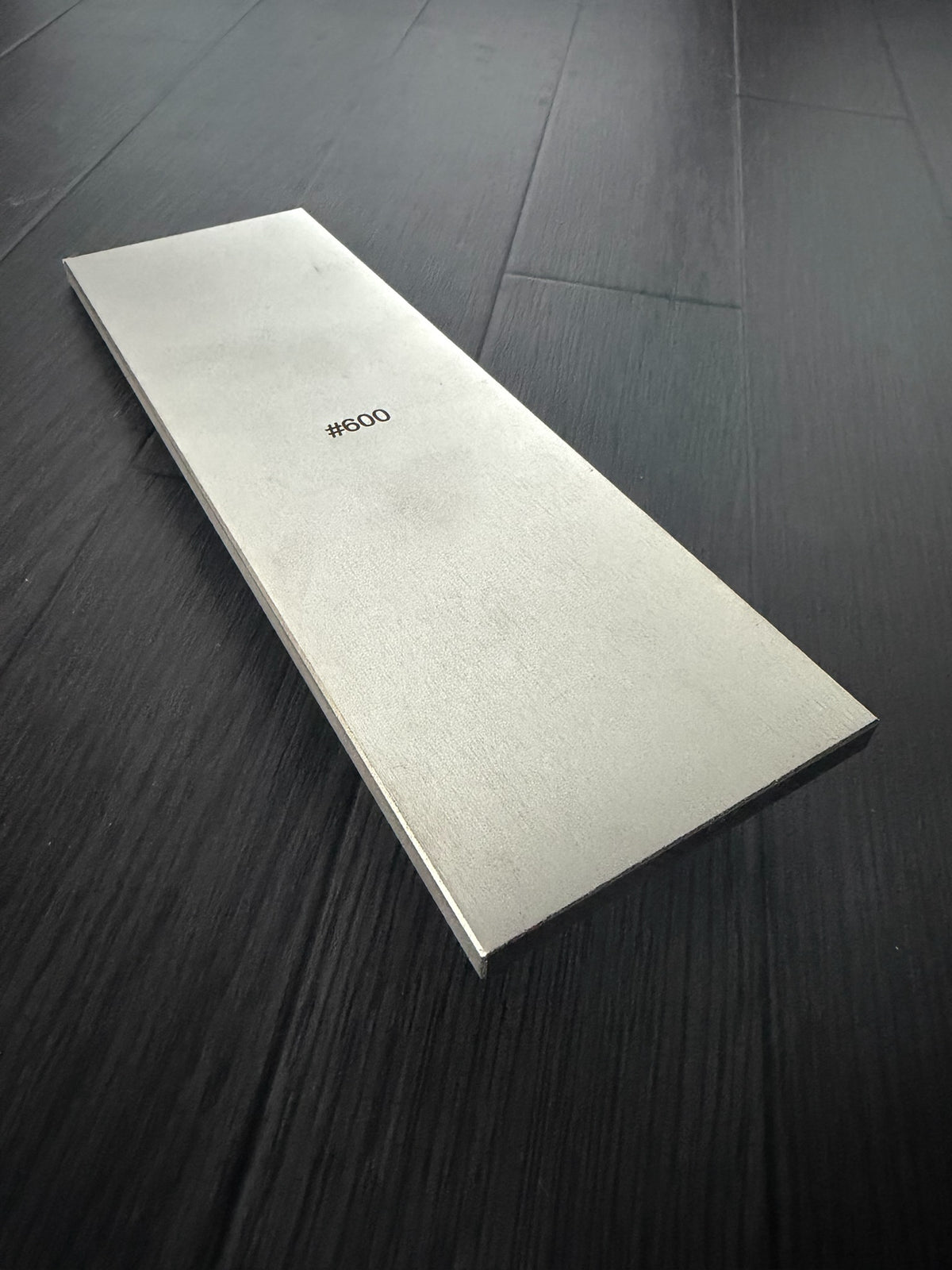
#600 — Flatten & Maintain
The #600 diamond surface provides controlled cutting action for regular flattening and correcting normal surface wear.
It allows you to restore a consistent working surface efficiently while maintaining greater control over how much material is removed from the stone.
#1000 — Refine & Condition
The #1000 diamond surface provides finer conditioning for refining the working surface after flattening or for stones that require only light maintenance.
Together, the two surfaces allow you to move naturally from controlled flattening to finer surface refinement, giving you greater control over the final condition of your whetstone.
Don't Wait Until Your Stone Becomes a Problem
One of the easiest mistakes in sharpening is waiting too long to flatten a stone.
A slightly uneven stone may not immediately appear problematic. But continued sharpening gradually increases the wear, and the larger the irregularity becomes, the more material must eventually be removed to restore the surface.
Regular maintenance takes a different approach.
By correcting small amounts of wear as they develop, you can keep the stone consistently flat while avoiding unnecessary removal of valuable abrasive material.
This is especially worthwhile with premium synthetic stones, fine sharpening stones, and frequently used professional stones.
Maintain little and often — rather than correcting more later.
Designed Specifically for Whetstone Flattening
This is not simply a general-purpose diamond abrasive plate.
These diamond flattening tools are developed specifically for maintaining whetstones used in knife sharpening, with the working surface designed to provide the flatness required for this purpose.
That distinction matters.
When a flattening tool is used to establish the reference surface of a sharpening stone, the accuracy of the tool itself directly influences the surface you create.
A plate intended for general grinding or material removal may contain diamond abrasive, but that alone does not necessarily make it suitable as a reference for precision whetstone maintenance.
Here, the diamond surface is designed with knife-sharpening whetstone flattening in mind, helping maintain a consistent working plane from which accurate sharpening can begin.
The tool used to create a flat stone must itself be designed for the job.
Use More of the Stone You Paid For
A quality whetstone is a consumable tool — but that does not mean it should be consumed unnecessarily.
Every flattening removes some material.
The purpose of good stone maintenance is therefore not simply to make a stone flat. It is to achieve the surface you need while removing only what is necessary.
The controlled #600 / #1000 combination is particularly well suited to this philosophy.
Regular, measured maintenance helps preserve the usable thickness of your whetstones and allows you to get more working life from the stones you have invested in.
Remove what needs to be removed — not more.
Surface Condition Matters, Not Just Flatness
Flattening is only part of stone maintenance.
The condition and texture of the working surface can also influence how a whetstone feels and performs against the blade.
The #1000 diamond surface gives this plate an additional role in fine surface conditioning, allowing the sharpener to refine the stone after flattening and prepare a more controlled working surface for the next sharpening stage.
This can be particularly valuable when maintaining finer sharpening stones, where surface condition matters just as much as basic flatness.
Protect the Performance — and Life — of Your Whetstones
A quality whetstone is an investment.
Continuing to sharpen on an uneven surface can compromise consistency and make accurate blade-to-stone contact increasingly difficult.
Regular flattening helps maintain a predictable working surface and allows the whetstone to perform more consistently throughout its usable life.
This becomes particularly important when working with Japanese knives, single-bevel knives, wide bevels, thinning, and precision geometry work, where the condition of the stone directly influences how the blade contacts the abrasive.
A flat, properly conditioned stone gives the sharpener a reliable reference surface.
Accuracy begins with the surface beneath the blade.
Particularly Valuable for Precision Sharpening
A consistently maintained stone becomes increasingly important when working with:
Japanese single-bevel knives, wide bevels, thinning, bevel correction, and other precision geometry work.
These techniques involve a larger area of the blade contacting the stone, making surface consistency particularly important.
Even relatively small irregularities in the stone can gradually influence the geometry being created on the blade.
Maintaining a flat, properly conditioned surface gives the sharpener a more reliable reference from which precise work can be performed.
Precision at the blade begins with precision at the stone.
Substantial Weight. Stable, Controlled Contact.
At approximately 689 g, this is a substantial diamond flattening plate.
Its weight gives it a stable, reassuring feel in use and helps maintain controlled contact between the diamond surface and the whetstone during flattening and conditioning.
With dimensions of 213 × 64 × 7 mm, the plate provides a generous working surface for commonly used Japanese whetstones while remaining practical to handle and store.
The result is a simple tool with an important purpose:
keeping the surface you sharpen on consistent.
Why YAMANI Selects It
At YAMANI, we regard stone maintenance as part of sharpening itself.
A whetstone is not simply an abrasive. Its flatness and surface condition directly influence how the blade meets the stone and therefore the geometry and finish that can be achieved.
For regular maintenance, the objective should not be to remove as much stone as possible.
It should be to maintain accuracy while preserving as much of the whetstone as possible.
The fact that this tool is developed specifically for maintaining knife-sharpening whetstones is also important to us. A diamond abrasive alone is not enough — for flattening, the plate itself must provide a reliable reference surface for the stone being maintained.
The double-sided #600 / #1000 electroplated diamond construction provides two useful levels of controlled maintenance — #600 for maintaining flatness and correcting normal surface wear, and #1000 for finer surface conditioning and refinement.
For anyone who uses quality whetstones regularly, maintaining the stone is part of protecting both its performance and its working life.
Maintain the stone before the stone begins affecting your sharpening.
Specifications
Product: Double-Sided Diamond Whetstone Flattening Plate
Abrasive: Electroplated Diamond
Grit: #600 / #1000
Sides: Double-Sided
Dimensions: 213 × 64 × 7 mm
Weight: Approx. 689 g
Primary Use: Regular whetstone flattening and fine surface conditioning
#600 Side: Controlled flattening / regular surface maintenance
#1000 Side: Fine conditioning / surface refinement
Design Purpose: Specifically developed for flattening whetstones used in knife sharpening
Share