[Important Notice for US Customers]
Due to current US import regulations, please contact us before placing your order. We will confirm the shipping cost, import duties and taxes applicable to your order and provide you with the final amount before payment. ▶Contact usYAMANI SHODOSHIMA
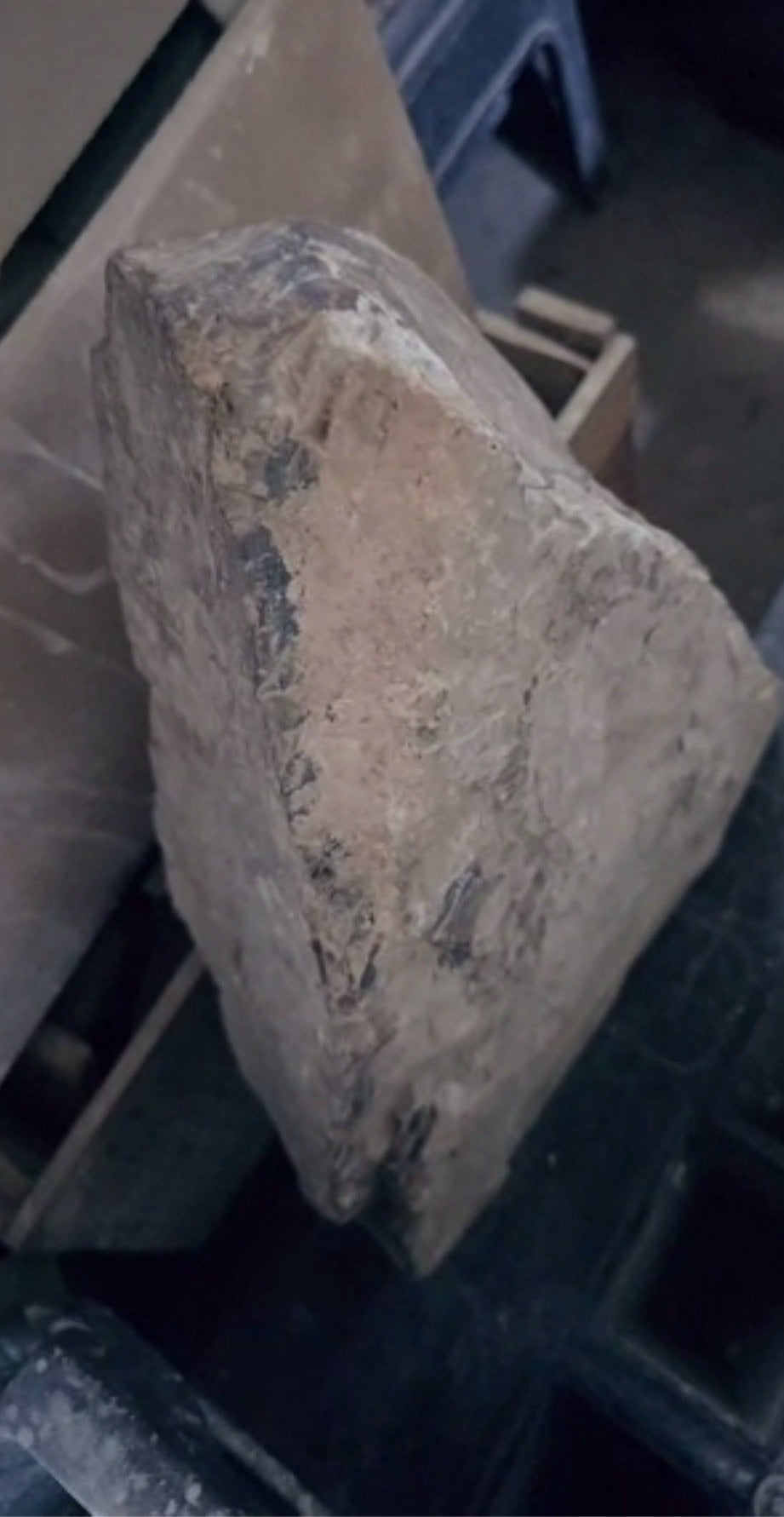
Ohira Uchigumori (Finishing Whetstone), Karasu (Crow Pattern), 871g from Ohira Mine, Kyoto
Ohira Uchigumori (Finishing Whetstone), Karasu (Crow Pattern), 871g from Ohira Mine, Kyoto
Couldn't load pickup availability
Ohira Uchigumori-Karasu (Crow Pattern), 871g, Japanese Sword Polishing Stone, Ohira Mine, Kyoto
Uchigumori is one of the essential natural stones used in the traditional polishing of Japanese swords. Rather than simply sharpening an edge, it is used during the finishing process to refine the blade surface to gradually reveal the jigane — the natural grain and texture of the forged steel — as well as the hamon (temper line).
This piece was freshly cut directly from a larger block of Ohira Uchigumori rough stone. Rather than being an old-stock stone of uncertain origin, its provenance can be traced directly to the original material from which it was cut.
Karasu (Crow Pattern) — A Unique Expression of Nature
Named after the Japanese word for “crow,” Karasu refers to the distinctive dark pattern occasionally seen in Japanese natural whetstones. Each pattern is naturally formed and entirely unique, giving every stone its own character and presence.
Beautiful Karasu stones are especially admired among natural whetstone enthusiasts — not simply as polishing stones, but as individual pieces shaped by nature.
This specimen shows a particularly attractive and clearly visible Karasu pattern across its working surface.
Details
• Origin: Ohira, Kyoto, Japan
• Type: Uchigumori natural Japanese finishing stone
• Weight: 871g
• Size: (approx) 175×65×30mm
Please note: This is a natural stone. Variations in color, texture, layers, and surface are natural characteristics and are not considered defects.
And the dimensions are approximate and may vary slightly across the stone. The shape is not perfectly uniform, with some areas being longer or shorter than others.
Natural Stone Base & Preparation
If the stone does not sit securely or rocks during use, lightly flatten only the necessary high points on the underside with a whetstone flattener or diamond plate until the stone sits stable. Alternatively, the stone may be mounted to a wooden base with a suitable adhesive for greater stability during sharpening.
We do not recommend completely removing the natural skin unless necessary. The remaining skin, geological features, and appearance of the stone can provide valuable clues when assessing its origin, geological layer, and individual character. They are also part of the identity of each natural stone.
For this reason, we recommend preserving as much of the original underside as possible and flattening only what is necessary for the stone to sit securely and safely during use.
Should you have any questions, please feel free to contact us.
Share