[Important Notice for US Customers]
Due to current US import regulations, please contact us before placing your order. We will confirm the shipping cost, import duties and taxes applicable to your order and provide you with the final amount before payment. ▶Contact usYAMANI SHODOSHIMA
First-Generation Bizen Osafune Sukenaga — Selected at the 2026 NBTHK Japanese Sword Crafts Competition
First-Generation Bizen Osafune Sukenaga — Selected at the 2026 NBTHK Japanese Sword Crafts Competition
Couldn't load pickup availability
First-Generation Bizen Osafune Sukenaga
A Japanese Sword from the Tenpō Era (1830–1844), Later Selected in the 2026 NBTHK Japanese Sword Crafts Competition
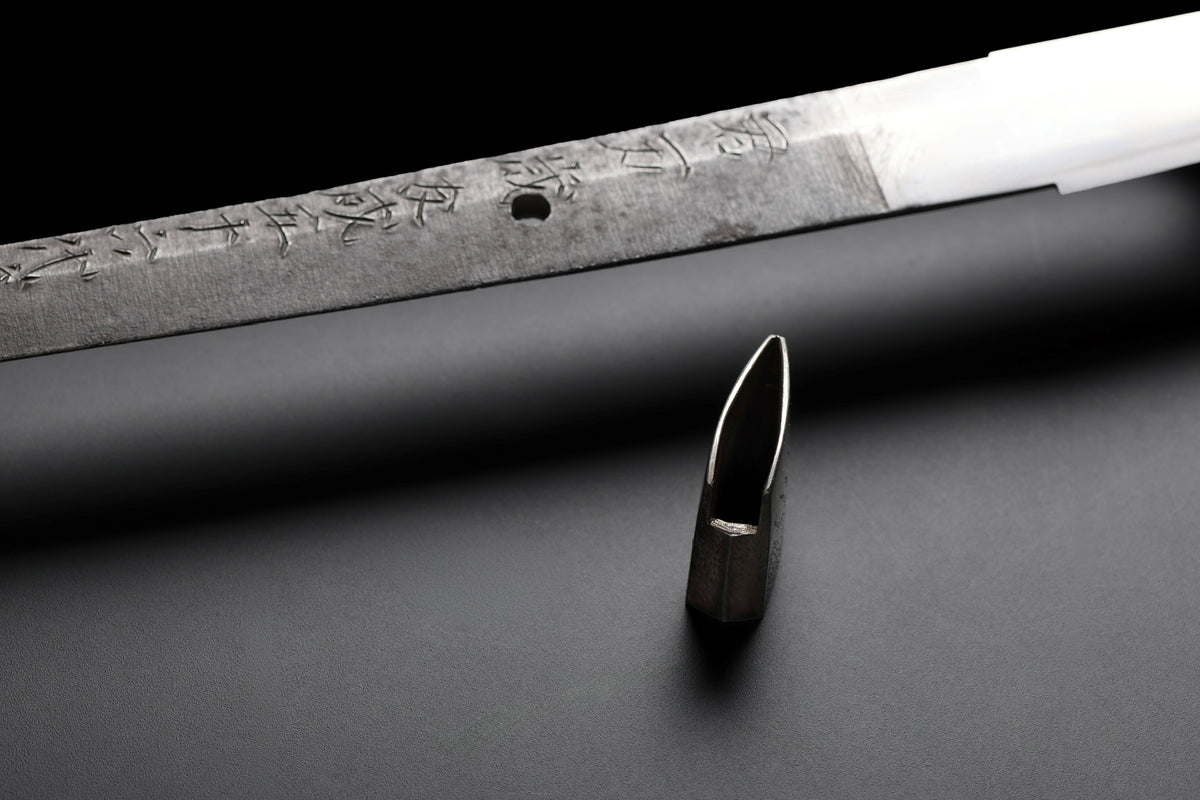
Signature — Omote (Front):
Yokoyama Kaga no Suke Fujiwara Sukenaga Saku
横山加賀介藤原祐永作
Inscription — Ura (Reverse):
Gojūrokudai no Magō — “56th-Generation Descendant”
五十六代孫
Kimibanzai Tomonari
君万歳友成
This Japanese sword was forged by first-generation Bizen Osafune Sukenaga, an important smith of the Yokoyama school who carried the traditions of Bizen Osafune into the final decades of the Edo period (1603–1868).
Sukenaga worked during the late Edo period, particularly around the Tenpō era (1830–1844).
In his inscriptions, Sukenaga used the phrase Gojūrokudai no Magō — “56th-generation descendant” — expressing his connection to the lineage of Tomonari, one of the celebrated early masters associated with the ancient Bizen swordmaking tradition.
Historical records state that Sukenaga received the honorary title Kaga no Suke in the second month of Tenpō 4 (1833).
The present sword is signed:
Yokoyama Kaga no Suke Fujiwara Sukenaga Saku
yet it does not bear the chrysanthemum crest and horizontal ichi mark seen on his later works.
This combination suggests that the sword may have been made relatively soon after Sukenaga received the Kaga no Suke title in 1833, during a comparatively early stage of his career.
The Unusual Inscription “Kimibanzai Tomonari”
One of the most intriguing features of this sword is the inscription on the reverse of the tang:
君万歳友成 — Kimibanzai Tomonari
The expression Kimibanzai can convey a wish for the longevity, prosperity, or enduring good fortune of another person.
Sukenaga also consciously identified himself with the lineage of the great early Bizen smith Tomonari through the inscription “56th-generation descendant,” making the presence of the name Tomonari particularly interesting.
It is possible that the sword was made to commemorate a close personal relationship, to express wishes for the longevity and prosperity of someone important to the smith, or perhaps in response to a special commission from such a person.
However, no surviving historical document currently confirms the precise circumstances behind this inscription. These possibilities should therefore be understood as interpretations rather than established historical fact.
It is precisely this uncertainty that makes the inscription so compelling: it leaves behind a rare personal element that invites us to consider why this particular sword was originally commissioned and for whom it may have been made nearly two centuries ago.
Fine Jigane and an Elegant Suguha Hamon
The jigane — the forged steel surface of the blade — displays a finely compacted itame-hada grain.
At first sight, the hamon appears as an elegant suguha, or predominantly straight temper line. Under closer observation, however, subtle sequences of small gunome activity can be seen within its restrained structure.
Fine nie particles are present, while the nioiguchi is tight and controlled.
The result is not an extravagant or visually overpowering hamon, but a refined and disciplined one.
This is particularly significant with suguha.
Compared with a highly flamboyant irregular hamon, a straight and restrained temper line leaves the quality of the underlying forged steel much more visually exposed. There is less decorative activity to distract the eye from the quality of the jigane itself.
For this reason, producing an accomplished suguha places considerable emphasis on the quality and refinement of the forging beneath it.
In this sword, the combination of the tightly forged steel and restrained straight hamon allows Sukenaga’s technical ability to be appreciated with unusual clarity.
Another noteworthy detail is that the signature does not end simply with “Sukenaga,” but with:
祐永作 — Sukenaga Saku
meaning “made by Sukenaga.”
The deliberate addition of saku (“made by”) is traditionally regarded in some contexts as an expression of a smith’s confidence or personal responsibility for the work. In this sword, it adds another interesting dimension to the character of the signature.
A Commanding Form Characteristic of the Shinshintō Period
The sword possesses a relatively long nakago (tang), a feature associated with the powerful proportions seen in many swords of the later Shinshintō period.
The Shinshintō period, generally dated approximately 1781–1876, was an important era of revival and experimentation in Japanese swordmaking.
The blade itself is long, and its extended tang indicates that it would originally have been mounted with a correspondingly substantial handle.
Even by the standards of the first half of the 19th century, this would likely have presented as a commanding and substantial sword.
During the final decades of the Edo period, particularly from the mid-19th century until the end of the Edo period in 1868, notable smiths representing different regional and technical traditions were active throughout Japan.
These included smiths associated with the Gassan tradition of Dewa, Nankai Tarō Chōson with his study of Yamashiro traditions, and the Mino-related master Okachiyama Nagasada.
At the same time, Bizen — once one of the greatest centers of Japanese sword production — no longer possessed the overwhelming dominance it had enjoyed during earlier centuries.
Against this historical background, Sukenaga and the Yokoyama school became important custodians of the centuries-old Bizen Osafune swordmaking tradition, carrying it forward into the 19th century.
First-generation Sukenaga is therefore regarded as one of the notable smiths representing the later history of the Bizen Osafune lineage.
A Fine Work by First-Generation Sukenaga
This sword can be regarded as a fine work (ryōsaku), standing above the level of an ordinary example of Sukenaga’s work.
The absence of the chrysanthemum crest and ichi mark seen on later Sukenaga blades should not in itself be interpreted as diminishing the quality or importance of the sword.
On the contrary, the combination of the Kaga no Suke title with the absence of these later marks is particularly interesting from a chronological perspective.
Since Sukenaga received the Kaga no Suke title in 1833, the characteristics of the inscription suggest the possibility that this blade was forged relatively soon afterward.
It may therefore offer an opportunity to appreciate the work of first-generation Sukenaga during a comparatively early stage of his career, before the signature style associated with his later works had become fully established.
Selected in the 2026 NBTHK Contemporary Japanese Sword Crafts Competition
Nearly two centuries after its creation, this sword acquired another important chapter in its history.
In 2026, this blade was submitted in the Shinogi-zukuri Polishing Division of the Contemporary Japanese Sword Crafts Exhibition, organized by the Society for the Preservation of Japanese Art Swords (NBTHK).
Despite its official English title containing the word “Exhibition,” this event is not simply an exhibition of Japanese swords.
It is also a judged competition for contemporary professionals working in the Japanese sword tradition, in which the technical skill and craftsmanship of specialists involved in the creation, polishing, restoration, and preservation of Japanese swords are formally evaluated.
In the polishing divisions, the focus is not on judging the historical swordsmith who originally forged the blade. Rather, the competition evaluates the skill of the contemporary polisher — the ability to understand the blade, preserve its geometry and form, and reveal the original swordsmith’s workmanship through traditional Japanese sword-polishing techniques.
This particular sword was entered in the Shinogi-zukuri Polishing Division, and its polishing received official selection in the 2026 competition.
Forged by first-generation Sukenaga around the 1830s, during the late Edo period (1603–1868), the sword has survived for approximately 190 years.
Through contemporary Japanese sword polishing, the qualities of its jigane, hamon, form, and original workmanship have once again been brought forward for appreciation.
Its appearance today therefore represents the meeting of two generations of Japanese craftsmanship:
the work of a Bizen Osafune swordsmith from the 19th century and the work of a Japanese sword polisher in the 21st century.
The latter was formally judged alongside the work of other contemporary sword craftsmen and received official selection in the 2026 NBTHK Contemporary Japanese Sword Crafts competition.
This gives the sword an especially meaningful modern provenance.
It is not simply a Japanese sword that has survived from the first half of the 19th century.
It is a blade whose original craftsmanship has been carefully brought forward through traditional polishing nearly two centuries later — with that polishing itself tested and recognized in a judged competition dedicated to the skills of contemporary Japanese sword craftsmen.
Shirasaya & Important Care Notice — A Fine Art Sword, Not a Martial-Arts Sword
This sword is currently preserved in a traditional shirasaya (plain wooden storage mounting) rather than in a complete koshirae mounting.
A shirasaya is intended primarily for the preservation and storage of the blade, allowing the Japanese sword itself to be safely maintained and appreciated.
Most importantly, this sword has received an exceptionally high-level traditional Japanese fine-art polish, designed to reveal and preserve the finest details of its jigane, hamon, nie, nioi, and the other subtle activities created by the original swordsmith.
For this reason, this sword must not be used for iaidō, battō, tameshigiri (test cutting), or any other form of martial-arts or practical sword use.
Fine-Art Polishing Is Fundamentally Different from Practical Sharpening
A Japanese sword preserved as a work of fine art and a sword prepared for martial-arts practice or cutting may both be Japanese swords, but the purpose and nature of their polishing are fundamentally different.
Traditional Japanese fine-art polishing is not simply a process of making a blade sharp.
It is a highly specialized traditional craft involving numerous stages, intended to reveal the structure of the forged steel, the hamon, nie, nioi, and the many subtle characteristics created by the swordsmith while preserving the blade’s geometry and historical integrity.
Once completed to this level, the polished surface is exceptionally delicate.
Even seemingly insignificant hairline scratches, scuffs, or hike can immediately compromise the integrity, appearance, and value of such a highly refined art polish.
Repeated drawing and resheathing of the blade, iaidō or battō practice, test cutting, or improper handling can all introduce these marks.
The Present Polish Is Part of This Sword’s Modern History
This point is particularly important with this sword because its present polishing was formally judged and selected in the Shinogi-zukuri Polishing Division of the 2026 NBTHK Contemporary Japanese Sword Crafts competition.
The polish should therefore be regarded not merely as maintenance performed on an old blade, but as an important part of this sword’s modern history and provenance.
A blade forged approximately 190 years ago by first-generation Bizen Osafune Sukenaga in the 19th century was brought into its present state of appreciation through the traditional skills of a 21st-century Japanese sword polisher, and that polishing was subsequently evaluated and recognized in a professional sword-craft competition.
For this reason, the sword should be treated strictly as a Japanese fine-art sword (Nihontō) intended for preservation, study, and appreciation, rather than as a sword for practical use.
We strongly recommend preserving it in its current shirasaya and avoiding unnecessary drawing and resheathing of the blade.
Please do not use this sword for iaidō, battō, tameshigiri, or cutting of any kind.
Once a fine-art polish of this level is scratched or damaged, it cannot simply be restored through ordinary sharpening or routine maintenance.
Preserving the present polished surface is part of preserving the sword itself for the next generation.
First-Generation Bizen Osafune Sukenaga
Yokoyama Kaga no Suke Fujiwara Sukenaga Saku
56th-Generation Descendant · Kimibanzai Tomonari
Late Edo Period — Tenpō Era (1830–1844)
A signature suggesting a relatively early work following Sukenaga’s receipt of the Kaga no Suke title in 1833.
A nakago that predates the chrysanthemum crest and ichi mark found on his later works.
Finely compacted jigane with itame-hada.
A restrained suguha hamon containing subtle gunome activity, fine nie, and a tightly controlled nioiguchi.
A commanding form characteristic of Japanese swords made during the Shinshintō period (approximately 1781–1876).
Preserved today in shirasaya and finished with a high-level traditional Japanese fine-art polish.
And, nearly two centuries after its creation:
Official Selection — 2026 NBTHK Contemporary Japanese Sword Crafts Competition, Shinogi-zukuri Polishing Division
A historic Japanese sword forged in the 19th century, whose present polishing was formally judged and selected in a competition recognizing the technical skill of contemporary Japanese sword craftsmen.
This is a Japanese sword in which the Bizen Osafune swordmaking tradition of the 19th century and the living art of Japanese sword polishing in the 21st century meet within a single blade.
Important Notice:
The sword is intended exclusively for preservation, study, and appreciation as a work of Japanese sword art. It is not intended for iaidō, battō, tameshigiri, or any form of practical cutting.
Share